
 Better Mistakes



音乐
暂未播放
姿态的数学:旋转、四元数与 IMU 仿真器
先看三个数:同一份 120 秒的 IMU 数据,只用陀螺仪积分,姿态误差最后涨到 41.9 度;只用加速度计加磁力计逐点求解(TRIAD),整段的均方根误差是 5.702 度;Mahony 互补滤波是 4.881 度。这三个数里最有意思的是最后那个:它在 20 到 60 秒的平静段只有 0.758 度,在 90 到 100 秒的磁干扰段是 14.851 度。一个滤波器的好坏,要看它怎么对付”传感器在说谎”的时刻。
这一篇不做卡尔曼滤波。它把后面四篇需要的全部材料备齐:姿态的数学、一个能造出这种谎言的仿真器,和三个不用协方差的基线,卡尔曼滤波器之后要和它们比。
这一篇结束时你会有:make ch04 通过,data/imu_seed1.csv(12000 个样本的仿真 IMU 日志),out/ch04/ 下 gyro、triad、mahony 三种方法在四种语言下的输出,三张图;C、C++、Rust 里的四元数模块(kl_quat、quat.hpp、quat.rs)、Mahony 滤波器和 TRIAD。四元数恒等式的自检在每个语言的 app 里先于数据处理运行。
前置:第 3 篇。需要的数学:向量叉乘、矩阵指数的概念。
约定
这些约定在这一篇陈述一次,之后原样沿用。
- 世界系 NED(北东地),机体系 FRD(前右下)。重力加速度 m/s²,世界系下 。
- 四元数用 Hamilton 约定,标量在前:。 把机体系向量旋转到世界系:,对应的旋转矩阵记作 (机体到世界)。
- 运动学 ,离散形式 (这里的 在下面定义)。
- 误差定义(右乘,局部/机体系误差):,姿态误差向量 ,规范化为 。
- 欧拉角用 ZYX 顺序(偏航、俯仰、横滚),只用于显示和报告误差,误差折到 。我会报告三个轴各自的欧拉角 RMSE(度)和总的旋转角误差 的 RMSE(度)。
- 传感器模型:
- 陀螺:, 随机游走。
- 加速度计测比力:。
- 磁力计:,(单位长度,磁倾角 50 度向下,磁偏角 0)。
数学
旋转矩阵与 SO(3)
一个把机体系坐标变成世界系坐标的旋转,写成矩阵 ,满足 和 。所有这样的矩阵组成群 SO(3):两个旋转相乘还是旋转,逆就是转置。它有 9 个数,但只有 3 个自由度,6 个约束把它压到一个三维曲面上。这个”3 个自由度、不能随便加减”的性质,是整个姿态估计比标量滤波难的原因。
欧拉角与万向锁
最直观的 3 参数表示是欧拉角。ZYX 顺序:先绕 转横滚角 ,再绕 转俯仰角 ,再绕 转偏航角 ,
(、 是余弦和正弦的缩写。)它的毛病在 :,,矩阵化简成
只依赖 ,而不是它们各自的值:偏航和横滚退化成同一个自由度,丢了一个。这就是万向锁。数值验证: 和 (差值都是 )在 给出的矩阵,最大元素差是 ,是同一个旋转。
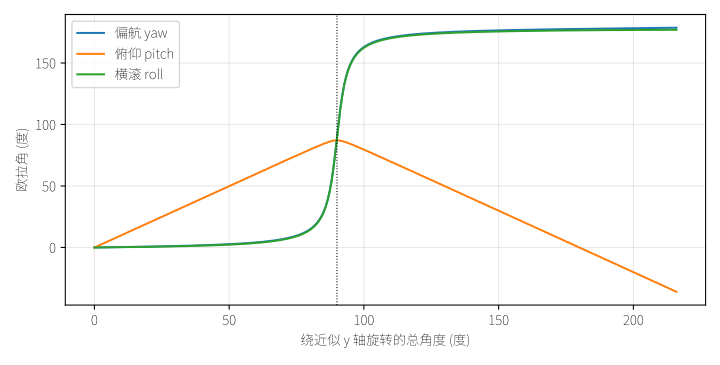
在奇异点附近,一个很小的旋转会让偏航和横滚剧烈变化。我这份仿真数据里,真值的俯仰角在 之间摆动,离奇异点不到 10 度,这意味着后面报告的偏航、横滚的欧拉角 RMSE 会被放大。总旋转角误差 没有这个毛病,所以我把它当作主要指标。结论:欧拉角只用来显示,滤波器内部不用。
轴角、Rodrigues 与指数映射
另一个 3 参数表示是旋转向量 :绕单位轴 转角度 。Rodrigues 公式把它变成矩阵:
。推导:把向量 分解成沿轴的分量 和垂直分量 ;沿轴的不变,垂直分量在垂直平面内转 :。合起来 ,用 和 整理即得。
这个 就是 SO(3) 上的指数映射 ,反方向是对数映射。它是后面所有章节的基本工具:小的旋转,用 3 维向量表示,可以随便加、随便做线性运算;大的旋转,用指数映射接到群上。
四元数
四元数是 4 维的 ,。乘法(Hamilton 积):
共轭 ,范数 ,单位四元数 的逆等于共轭。单位四元数 表示绕 转 。这里有一个双重覆盖: 与 是同一个旋转( 与 给出相反符号)。我的约定是误差四元数规范化到 。
四元数旋转向量。 把 嵌成 ,计算 。先算 ,再乘 ,向量部分是
;(三重积展开)。代入得
这个式子很重要:它的第一种写法是 (便于推导),第二种写法是矩阵 (便于实现),对应代码里的 qrot。第 5 篇求雅可比时会用到它。
指数映射与对数映射。 旋转向量 对应的四元数是
(我写 指的是旋转向量 对应的四元数,在级数记号里它是 。) 时 ,,代码里 就用这个一阶展开,免得除以零。反方向:(先把 规范化到 )。用 而不是 ,在小角度时数值上稳得多。
运动学。 设机体以角速度 (机体系表示)转动。经过一小段 ,机体系相对于上一时刻的机体系,转了一个小旋转 ,所以
(右乘,因为 是在机体系里表示的。)展开一阶项,。如果 在整个 内恒定,那么 是精确的,不是近似:这正是离散模型。这条精确式的好处是不需要小步长假设,也永远保持单位范数(至多舍入误差,代码里再归一化一次)。
小角度近似。 ,误差是 。第 6 篇的误差状态滤波器整个建立在它上面。
斜对称矩阵。 把叉乘变成矩阵乘法,上面已经定义。后面经常用到性质:。
三个传感器测的是什么
- 陀螺仪测机体系下的角速度,加上零偏和噪声。零偏是缓慢变化的,不能被忽略:我的仿真里初始零偏是 rad/s,不处理它,120 秒会积出 rad 的误差。
- 加速度计测的不是重力加速度,而是比力(specific force):。静止时 ,,机体水平时是 :加速度计”感觉到的”是地面向上的支持力,在 FRD 系下 轴向下,所以读数是负的。线性加速度会直接污染它,这是它的致命弱点。
- 磁力计测地磁场在机体系下的方向。我们已知世界系下的磁场 。
为什么加速度计只给横滚和俯仰,磁力计给偏航
加速度计提供一个世界系已知方向(竖直方向)在机体系下的观测。一个方向观测只约束两个自由度:把竖直轴对齐之后,绕竖直轴转任意角度,观测都不变,那就是偏航。所以加速度计能得到横滚和俯仰,得不到偏航。磁力计提供第二个方向(磁场方向),它和重力方向不平行(有 50 度磁倾角),两个不平行的方向合起来约束全部 3 个自由度。
TRIAD 就是用这一点的最小方案:用两个方向观测直接构造出姿态。机体系观测 (比力的方向)、(磁场方向),世界系参考 、。分别构造正交标架:
,把机体系标架旋转到世界系标架。第一个向量(这里是比力方向)被精确对齐,第二个向量只有垂直于第一个向量的部分被使用,这意味着 TRIAD 把全部可信度给了加速度计,磁力计只用来定偏航。它没有滤波,每个样本独立计算,噪声和扰动直接传进来。
仿真器
仿真器只在 Python 里(python/kl/imu_sim.py):C、C++、Rust 的任务是处理已经记录好的数据,这也正是硬件上的工作流。
真值。 机体系角速度
以 1 kHz 用精确四元数指数积分(每步用区间中点的角速度),初始姿态是单位四元数,每 10 步取一个样本,得到 100 Hz 的 IMU 数据,120 秒共 12000 个样本。三个轴用互不通约的频率,是为了让姿态在 120 秒内不重复。
陀螺。 陀螺读数是区间平均角速度 加零偏加噪声。用区间平均而不是采样时刻的瞬时值,是因为第 3 篇那个教训:离散滤波模型 隐含的就是平均角速度,瞬时值会在滤波器和仿真器之间留下一个系统性的模型差。
噪声与零偏。 陀螺每样本噪声 rad/s,零偏初值 rad/s,随机游走 rad/s/(每样本标准差 )。加速度计 m/s²,磁力计 (单位场)。这些是典型消费级 MEMS 的量级,不是某个具体型号的数据手册。
两段扰动。
- 线性加速度: 秒内加上世界系下 m/s²,CSV 里
acc_dist = 1。 - 磁干扰: 秒内世界系磁场被加上 ,CSV 里
mag_dist = 1。
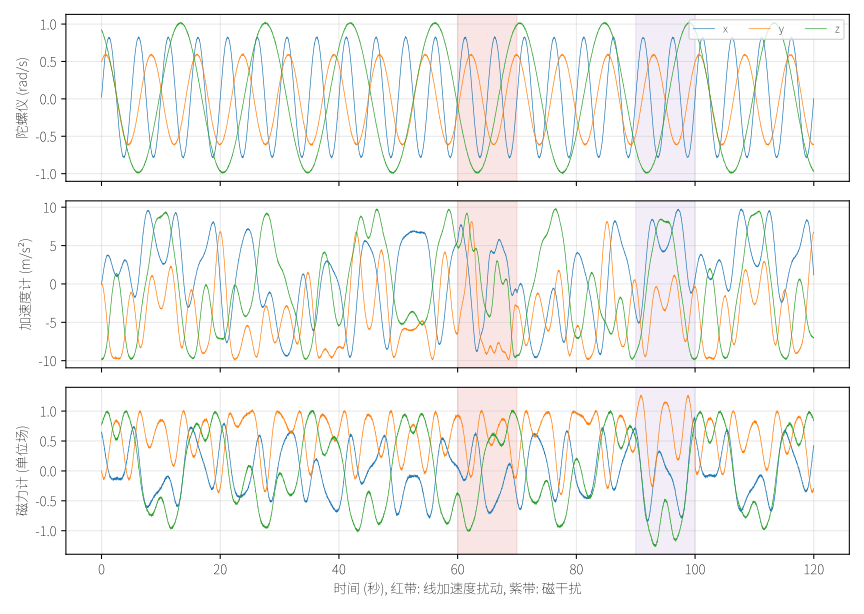
CSV 的列是 t,gx,gy,gz,ax,ay,az,mx,my,mz,qw,qx,qy,qz,bx,by,bz,acc_dist,mag_dist。滤波器不允许读后面的 9 列(真值四元数、真零偏和扰动标志),它们只在评估时用。种子 1 用于单次运行,之后的蒙特卡洛用种子 1 到 50。
Mahony 互补滤波
第 1 篇留了一个观察:常增益的一维卡尔曼滤波,就是对”陀螺推进后的预测”做一阶低通,加速度计提供低频、陀螺提供高频。Mahony 滤波器是它在 SO(3) 上的非线性版本。
设当前估计 ,它预测的世界系方向在机体系下是 (竖直)和 (磁场)。实际测到的单位向量 ,。我们要一个小的机体系旋转 ,使预测向量对准测量向量。给 右乘 之后,新预测是 。要它等于测量 ,解 ;对单位向量,垂直于 的那部分有解 (验证:,正好是 垂直于 的分量)。两个观测的修正取和:
就是”当前估计与测量之间的失配”,是个机体系下的小旋转向量。Mahony 把它当作角速度的修正项,并且对它积分来估计零偏:
的符号是这么确定的:稳态下 (失配平衡掉零偏误差),所以 是负的零偏误差的 倍;要让 趋向 ,需要 沿 方向增长,即 。
控制”多快相信测量”,对应第 1 篇 (时间常数的倒数); 控制零偏估计多快。我取 , 作为基线,没有调。
它的局限也很明显: 只是方向失配的几何修正,没有协方差,不知道哪个传感器此刻更可信,加速度计和磁力计的权重固定相等;磁干扰会通过 直接改变横滚和俯仰,而不仅仅是偏航(下面的数据会看到)。第 5 篇之后的卡尔曼滤波器要解决的就是这几件事。
另外两个基线:纯陀螺积分(初始姿态用第一个样本的 TRIAD,之后只积分陀螺),TRIAD(每个样本独立求解)。
Python 实现
四元数
"""Quaternion helpers. Hamilton convention, scalar first q = [w, x, y, z].
q rotates body to world: v_w = q (x) [0, v_b] (x) q*, and C(q) = C_wb.`qexp(v)` is the unit quaternion of the rotation by rotation vector v, i.e. theexp(v/2) of the series notation: [cos(|v|/2), sin(|v|/2) v/|v|]."""
import numpy as np
SMALL = 1e-8 # below this angle (rad) use the Taylor expansion
def qmul(a, b): aw, ax, ay, az = a bw, bx, by, bz = b return np.array([ aw * bw - ax * bx - ay * by - az * bz, aw * bx + ax * bw + ay * bz - az * by, aw * by - ax * bz + ay * bw + az * bx, aw * bz + ax * by - ay * bx + az * bw, ])
def qconj(q): return np.array([q[0], -q[1], -q[2], -q[3]])
def qnormalize(q): return q / np.sqrt(q @ q)
def qexp(v): """Rotation vector -> unit quaternion.""" th = np.sqrt(v @ v) if th < SMALL: return np.array([1.0 - th * th / 8.0, *(0.5 * v)]) s = np.sin(0.5 * th) / th return np.array([np.cos(0.5 * th), *(s * v)])
def qlog(q): """Unit quaternion -> rotation vector, using the sign with w >= 0 (angle in [0, pi]).""" if q[0] < 0: q = -q u = q[1:] n = np.sqrt(u @ u) if n < SMALL: return 2.0 * u / q[0] return (2.0 * np.arctan2(n, q[0]) / n) * u
def qrot(q): """Direction cosine matrix C(q) = C_wb (body -> world).""" w, x, y, z = q return np.array([ [1 - 2 * (y * y + z * z), 2 * (x * y - w * z), 2 * (x * z + w * y)], [2 * (x * y + w * z), 1 - 2 * (x * x + z * z), 2 * (y * z - w * x)], [2 * (x * z - w * y), 2 * (y * z + w * x), 1 - 2 * (x * x + y * y)], ])
def dcm_to_quat(C): """C_wb -> unit quaternion with w >= 0 (Shepperd's method).""" t = C[0, 0] + C[1, 1] + C[2, 2] if t > 0: s = 2.0 * np.sqrt(1.0 + t) q = np.array([0.25 * s, (C[2, 1] - C[1, 2]) / s, (C[0, 2] - C[2, 0]) / s, (C[1, 0] - C[0, 1]) / s]) elif C[0, 0] >= C[1, 1] and C[0, 0] >= C[2, 2]: s = 2.0 * np.sqrt(1.0 + C[0, 0] - C[1, 1] - C[2, 2]) q = np.array([(C[2, 1] - C[1, 2]) / s, 0.25 * s, (C[0, 1] + C[1, 0]) / s, (C[0, 2] + C[2, 0]) / s]) elif C[1, 1] >= C[2, 2]: s = 2.0 * np.sqrt(1.0 + C[1, 1] - C[0, 0] - C[2, 2]) q = np.array([(C[0, 2] - C[2, 0]) / s, (C[0, 1] + C[1, 0]) / s, 0.25 * s, (C[1, 2] + C[2, 1]) / s]) else: s = 2.0 * np.sqrt(1.0 + C[2, 2] - C[0, 0] - C[1, 1]) q = np.array([(C[1, 0] - C[0, 1]) / s, (C[0, 2] + C[2, 0]) / s, (C[1, 2] + C[2, 1]) / s, 0.25 * s]) return -q if q[0] < 0 else q
def skew(v): return np.array([[0.0, -v[2], v[1]], [v[2], 0.0, -v[0]], [-v[1], v[0], 0.0]])
def euler_zyx(q): """(yaw, pitch, roll) in radians for C_wb = Rz(yaw) Ry(pitch) Rx(roll).""" w, x, y, z = q yaw = np.arctan2(2 * (w * z + x * y), 1 - 2 * (y * y + z * z)) pitch = np.arcsin(np.clip(2 * (w * y - z * x), -1.0, 1.0)) roll = np.arctan2(2 * (w * x + y * z), 1 - 2 * (x * x + y * y)) return yaw, pitch, roll
def att_error(q_est, q_true): """Attitude error vector dtheta = 2 log(q_est^-1 (x) q_true), in the estimate's body frame.""" return qlog(qmul(qconj(q_est), q_true))
def wrap_pi(a): """Wrap an angle to [-pi, pi).""" return (a + np.pi) % (2 * np.pi) - np.pi每个函数都对应上面的一条公式。几点实现细节:
qexp和qlog在SMALL = 1e-8以下走泰勒展开,这个阈值在四种语言里完全一致,否则小角度那一支的舍入会出现跨语言差异。qlog先把 的四元数取反,保证返回的是 内最短的旋转。dcm_to_quat是 Shepperd 方法:对矩阵的迹和三个对角元里最大的那个分情况,避免对接近零的数开方后再相除。euler_zyx里np.clip防止舍入误差把arcsin的参数推到 之外。att_error返回 ,没有乘 2:qlog本身已经返回旋转向量(含了那个 2),它就是约定里的 。
仿真器
"""IMU simulator: truth attitude, gyro, accelerometer, magnetometer (NED world, FRD body)."""
from pathlib import Path
import numpy as np
from .io import write_csv
ROOT = Path(__file__).resolve().parents[2]
G = 9.80665GRAVITY_W = np.array([0.0, 0.0, G])DIP = np.radians(50.0)MAG_W = np.array([np.cos(DIP), 0.0, np.sin(DIP)])
GYRO_SIGMA = 0.005 # rad/s per sampleBIAS0 = np.array([0.02, -0.01, 0.015]) # rad/sBIAS_RW = 1e-4 # rad/s/sqrt(s)ACC_SIGMA = 0.05 # m/s^2MAG_SIGMA = 0.01 # unit-norm fieldACC_WINDOW = (60.0, 70.0)MAG_WINDOW = (90.0, 100.0)MAG_DISTURB = np.array([0.3, 0.3, 0.0])
def rate_b(t): """True body angular rate (rad/s).""" return np.array([ 0.8 * np.sin(2 * np.pi * 0.20 * t), 0.6 * np.sin(2 * np.pi * 0.13 * t + 1.0), 1.0 * np.sin(2 * np.pi * 0.07 * t + 2.0), ])
def _qmul(a, b): # plain-float quaternion product, hot loop aw, ax, ay, az = a bw, bx, by, bz = b return (aw * bw - ax * bx - ay * by - az * bz, aw * bx + ax * bw + ay * bz - az * by, aw * by - ax * bz + ay * bw + az * bx, aw * bz + ax * by - ay * bx + az * bw)
def _qexp(v): th = (v[0] * v[0] + v[1] * v[1] + v[2] * v[2]) ** 0.5 if th < 1e-8: return (1.0 - th * th / 8.0, 0.5 * v[0], 0.5 * v[1], 0.5 * v[2]) s = np.sin(0.5 * th) / th return (np.cos(0.5 * th), s * v[0], s * v[1], s * v[2])
def a_world(t): """Linear acceleration disturbance (world frame, m/s^2).""" if ACC_WINDOW[0] <= t < ACC_WINDOW[1]: return np.array([2.0 * np.sin(2 * np.pi * 0.5 * t), 0.0, 0.0]) return np.zeros(3)
def simulate(seed, duration=120.0, imu_rate=100.0, truth_rate=1000.0, write=True): from .quat import qconj, qlog, qrot
rng = np.random.default_rng(seed) dt = 1.0 / imu_rate sub = int(round(truth_rate / imu_rate)) h = 1.0 / truth_rate n = int(round(duration * imu_rate))
# truth attitude at the IMU sample instants, integrated at truth_rate # (exact quaternion exponential of the mid-interval rate); one extra step # before t = 0 gives the first sample its average rate as well. q = (1.0, 0.0, 0.0, 0.0) qs = np.empty((n, 4)) for k in range(n): qs[k] = q for j in range(sub): t_mid = k * dt + (j + 0.5) * h q = _qmul(q, _qexp(rate_b(t_mid) * h)) nq = (q[0] ** 2 + q[1] ** 2 + q[2] ** 2 + q[3] ** 2) ** 0.5 q = tuple(c / nq for c in q)
# gyro reports the rate averaged over the sample interval: rotvec(q_{k-1}^-1 q_k) / dt. # For k = 0 there is no previous sample, so use the instantaneous rate. avg = np.empty((n, 3)) avg[0] = rate_b(0.0) for k in range(1, n): avg[k] = qlog(_qmul_np(qconj(qs[k - 1]), qs[k])) / dt
bias = np.empty((n, 3)) bias[0] = BIAS0 bias[1:] = BIAS0 + np.cumsum(BIAS_RW * np.sqrt(dt) * rng.standard_normal((n - 1, 3)), axis=0) gyro = avg + bias + GYRO_SIGMA * rng.standard_normal((n, 3))
t = np.arange(n) * dt acc = np.empty((n, 3)) mag = np.empty((n, 3)) acc_dist = np.zeros(n) mag_dist = np.zeros(n) na = ACC_SIGMA * rng.standard_normal((n, 3)) nm = MAG_SIGMA * rng.standard_normal((n, 3)) for k in range(n): C = qrot(qs[k]) aw = a_world(t[k]) mw = MAG_W.copy() if MAG_WINDOW[0] <= t[k] < MAG_WINDOW[1]: mw = mw + MAG_DISTURB mag_dist[k] = 1.0 if ACC_WINDOW[0] <= t[k] < ACC_WINDOW[1]: acc_dist[k] = 1.0 acc[k] = C.T @ (aw - GRAVITY_W) + na[k] mag[k] = C.T @ mw + nm[k]
cols = { "t": t, "gx": gyro[:, 0], "gy": gyro[:, 1], "gz": gyro[:, 2], "ax": acc[:, 0], "ay": acc[:, 1], "az": acc[:, 2], "mx": mag[:, 0], "my": mag[:, 1], "mz": mag[:, 2], "qw": qs[:, 0], "qx": qs[:, 1], "qy": qs[:, 2], "qz": qs[:, 3], "bx": bias[:, 0], "by": bias[:, 1], "bz": bias[:, 2], "acc_dist": acc_dist, "mag_dist": mag_dist, } if write: write_csv(ROOT / "data" / f"imu_seed{seed}.csv", cols) return cols
def _qmul_np(a, b): from .quat import qmul
return qmul(a, b)热点循环(每个样本里 10 步指数积分)用普通元组实现 _qmul、_qexp,不走 numpy 小数组,120 秒的数据 4 秒内生成完。simulate 的结构:先积分真值,再由真值算出区间平均角速度,再叠加零偏和噪声,最后由真值姿态算加速度计和磁力计读数。
Mahony 与基线
"""Mahony explicit complementary filter with an integral bias term."""
import numpy as np
from .imu_sim import MAG_Wfrom .quat import qexp, qmul, qnormalize, qrot
class Mahony: """q <- q (x) exp((w_m - b + kp e) dt), b <- b - ki e dt, e = a_meas x a_pred + m_meas x m_pred (unit vectors in the body frame)."""
def __init__(self, kp, ki, q0, m_w=MAG_W): self.kp, self.ki = kp, ki self.q = np.asarray(q0, dtype=float).copy() self.b = np.zeros(3) self.m_w = m_w
def step(self, gyro, accel, mag, dt): C = qrot(self.q) a_pred = C.T @ np.array([0.0, 0.0, -1.0]) m_pred = C.T @ self.m_w a_n = accel / np.sqrt(accel @ accel) m_n = mag / np.sqrt(mag @ mag) e = np.cross(a_n, a_pred) + np.cross(m_n, m_pred) self.b = self.b - self.ki * e * dt w = gyro - self.b + self.kp * e self.q = qnormalize(qmul(self.q, qexp(w * dt))) return self.q"""Attitude baselines: TRIAD snapshot and gyro-only integration."""
import numpy as np
from .quat import dcm_to_quat, qexp, qmul, qnormalize
def triad(accel, mag, m_w): """Attitude q (body -> world) from one accelerometer + magnetometer snapshot.
Specific force at rest points opposite to gravity, [0, 0, -1] in the NED world frame. """ r1 = np.array([0.0, 0.0, -1.0]) r2 = m_w b1 = accel / np.sqrt(accel @ accel) b2 = mag / np.sqrt(mag @ mag)
def frame(v1, v2): t2 = np.cross(v1, v2) t2 = t2 / np.sqrt(t2 @ t2) return np.column_stack([v1, t2, np.cross(v1, t2)])
C = frame(r1, r2) @ frame(b1, b2).T # world <- body return dcm_to_quat(C)
def gyro_only(gyro, dt, q0): """Integrate raw gyro samples 1..n-1 starting from q0 at sample 0.""" n = len(gyro) q = np.asarray(q0, dtype=float).copy() out = np.empty((n, 4)) out[0] = q for k in range(1, n): q = qnormalize(qmul(q, qexp(gyro[k] * dt))) out[k] = q return outMahony.step 是上面三个公式的逐行翻译。triad 里的 frame 构造标架(三个列向量),C = frame(r1, r2) @ frame(b1, b2).T 是 。
C、C++、Rust 实现
四元数是这一章最典型的”同一个东西,三种语言三种惯用法”。
- C: 四元数是
kl_real[4],函数把结果写入调用者给的输出数组,输出不与输入别名。没有类型的区别,kl_real a[4]和kl_real v[3]在函数签名里只是文档。 - C++:
Quat<T>是带四个成员的结构体,重载operator*,Quat::exp(Vec3)是静态方法,q.log()返回Vec3。Vec3<T>是第 2 篇的Mat<3,1,T>,所以向量运算(+、-、*标量)直接可用。 - Rust:
Quat是Copy的结构体,impl Mul;向量用[Real; 3],旋转矩阵用Mat<3, 3>。
四元数乘法和指数/对数,三个版本放在一起看:
C
#include "kl/kl_quat.h"
#define SMALL ((kl_real)1e-8) /* below this angle (rad) use the Taylor expansion */
void kl_quat_mul(const kl_real *a, const kl_real *b, kl_real *out){ out[0] = a[0] * b[0] - a[1] * b[1] - a[2] * b[2] - a[3] * b[3]; out[1] = a[0] * b[1] + a[1] * b[0] + a[2] * b[3] - a[3] * b[2]; out[2] = a[0] * b[2] - a[1] * b[3] + a[2] * b[0] + a[3] * b[1]; out[3] = a[0] * b[3] + a[1] * b[2] - a[2] * b[1] + a[3] * b[0];}
void kl_quat_conj(const kl_real *a, kl_real *out){ out[0] = a[0]; out[1] = -a[1]; out[2] = -a[2]; out[3] = -a[3];}
void kl_quat_normalize(kl_real *q){ kl_real n = KL_SQRT(q[0] * q[0] + q[1] * q[1] + q[2] * q[2] + q[3] * q[3]); for (int i = 0; i < 4; i++) q[i] /= n;}
void kl_quat_exp(const kl_real v[3], kl_real q[4]){ kl_real th = KL_SQRT(v[0] * v[0] + v[1] * v[1] + v[2] * v[2]); if (th < SMALL) { q[0] = 1 - th * th / 8; for (int i = 0; i < 3; i++) q[1 + i] = (kl_real)0.5 * v[i]; return; } kl_real s = KL_SIN((kl_real)0.5 * th) / th; q[0] = KL_COS((kl_real)0.5 * th); for (int i = 0; i < 3; i++) q[1 + i] = s * v[i];}
void kl_quat_log(const kl_real q[4], kl_real v[3]){ kl_real sg = q[0] < 0 ? -1 : 1; kl_real w = sg * q[0], u[3] = {sg * q[1], sg * q[2], sg * q[3]}; kl_real n = KL_SQRT(u[0] * u[0] + u[1] * u[1] + u[2] * u[2]); kl_real k = n < SMALL ? 2 / w : 2 * KL_ATAN2(n, w) / n; for (int i = 0; i < 3; i++) v[i] = k * u[i];}kl_quat_mul(a, b, out) 的 out 不能与 a、b 是同一块内存:每个分量用到所有输入。Mahony 一步:
f->m_w[i] = m_w[i]; }}
void kl_mahony_step(kl_mahony *f, const kl_real gyro[3], const kl_real accel[3], const kl_real mag[3], kl_real dt){ kl_real C[9], a_pred[3], m_pred[3], a_n[3], m_n[3], e1[3], e2[3], e[3], w[3], dq[4], qn[4]; kl_quat_to_dcm(f->q, C); /* a_pred = C^T [0,0,-1], m_pred = C^T m_w */ for (int i = 0; i < 3; i++) { a_pred[i] = -C[6 + i]; m_pred[i] = C[i] * f->m_w[0] + C[3 + i] * f->m_w[1] + C[6 + i] * f->m_w[2]; } unit(accel, a_n); unit(mag, m_n); cross(a_n, a_pred, e1); cross(m_n, m_pred, e2); for (int i = 0; i < 3; i++) { e[i] = e1[i] + e2[i]; f->b[i] = f->b[i] - f->ki * e[i] * dt; w[i] = (gyro[i] - f->b[i] + f->kp * e[i]) * dt; } kl_quat_exp(w, dq); kl_quat_mul(f->q, dq, qn); kl_quat_normalize(qn); for (int i = 0; i < 4; i++) f->q[i] = qn[i];}a_pred = -C[6 + i]: 就是 乘以 的第三行,不需要完整的矩阵向量乘法。
完整源码:c/include/kl/kl_quat.h、c/src/kl_quat.c、c/include/kl/kl_mahony.h、c/src/kl_mahony.c、c/src/kl_baselines.c
/* Quaternions, Hamilton convention, scalar first q = [w, x, y, z]. * q rotates body to world: v_w = q (x) [0, v_b] (x) q*, and C(q) = C_wb (row-major 3x3). * Output buffers never alias inputs unless stated. */#ifndef KL_QUAT_H#define KL_QUAT_H
#include "kl/kl_real.h"
/* out = a (x) b */void kl_quat_mul(const kl_real *a, const kl_real *b, kl_real *out);void kl_quat_conj(const kl_real *a, kl_real *out);/* q = q / |q|, in place */void kl_quat_normalize(kl_real *q);/* Rotation vector -> unit quaternion [cos(|v|/2), sin(|v|/2) v/|v|]. */void kl_quat_exp(const kl_real v[3], kl_real q[4]);/* Unit quaternion -> rotation vector with angle in [0, pi] (q and -q give the same v). */void kl_quat_log(const kl_real q[4], kl_real v[3]);/* C(q) = C_wb */void kl_quat_to_dcm(const kl_real q[4], kl_real C[9]);/* C_wb -> unit quaternion with w >= 0 (Shepperd's method) */void kl_dcm_to_quat(const kl_real C[9], kl_real q[4]);/* S v = [v]x w = v x w */void kl_skew(const kl_real v[3], kl_real S[9]);/* C_wb = Rz(yaw) Ry(pitch) Rx(roll) */void kl_quat_to_euler_zyx(const kl_real q[4], kl_real *yaw, kl_real *pitch, kl_real *roll);/* v = log(est^* (x) tru): attitude error in the estimate's body frame */void kl_quat_error(const kl_real est[4], const kl_real tru[4], kl_real v[3]);
#endif#include "kl/kl_quat.h"
#define SMALL ((kl_real)1e-8) /* below this angle (rad) use the Taylor expansion */
void kl_quat_mul(const kl_real *a, const kl_real *b, kl_real *out){ out[0] = a[0] * b[0] - a[1] * b[1] - a[2] * b[2] - a[3] * b[3]; out[1] = a[0] * b[1] + a[1] * b[0] + a[2] * b[3] - a[3] * b[2]; out[2] = a[0] * b[2] - a[1] * b[3] + a[2] * b[0] + a[3] * b[1]; out[3] = a[0] * b[3] + a[1] * b[2] - a[2] * b[1] + a[3] * b[0];}
void kl_quat_conj(const kl_real *a, kl_real *out){ out[0] = a[0]; out[1] = -a[1]; out[2] = -a[2]; out[3] = -a[3];}
void kl_quat_normalize(kl_real *q){ kl_real n = KL_SQRT(q[0] * q[0] + q[1] * q[1] + q[2] * q[2] + q[3] * q[3]); for (int i = 0; i < 4; i++) q[i] /= n;}
void kl_quat_exp(const kl_real v[3], kl_real q[4]){ kl_real th = KL_SQRT(v[0] * v[0] + v[1] * v[1] + v[2] * v[2]); if (th < SMALL) { q[0] = 1 - th * th / 8; for (int i = 0; i < 3; i++) q[1 + i] = (kl_real)0.5 * v[i]; return; } kl_real s = KL_SIN((kl_real)0.5 * th) / th; q[0] = KL_COS((kl_real)0.5 * th); for (int i = 0; i < 3; i++) q[1 + i] = s * v[i];}
void kl_quat_log(const kl_real q[4], kl_real v[3]){ kl_real sg = q[0] < 0 ? -1 : 1; kl_real w = sg * q[0], u[3] = {sg * q[1], sg * q[2], sg * q[3]}; kl_real n = KL_SQRT(u[0] * u[0] + u[1] * u[1] + u[2] * u[2]); kl_real k = n < SMALL ? 2 / w : 2 * KL_ATAN2(n, w) / n; for (int i = 0; i < 3; i++) v[i] = k * u[i];}
void kl_quat_to_dcm(const kl_real q[4], kl_real C[9]){ kl_real w = q[0], x = q[1], y = q[2], z = q[3]; C[0] = 1 - 2 * (y * y + z * z); C[1] = 2 * (x * y - w * z); C[2] = 2 * (x * z + w * y); C[3] = 2 * (x * y + w * z); C[4] = 1 - 2 * (x * x + z * z); C[5] = 2 * (y * z - w * x); C[6] = 2 * (x * z - w * y); C[7] = 2 * (y * z + w * x); C[8] = 1 - 2 * (x * x + y * y);}
void kl_dcm_to_quat(const kl_real C[9], kl_real q[4]){ kl_real t = C[0] + C[4] + C[8], s; if (t > 0) { s = 2 * KL_SQRT(1 + t); q[0] = (kl_real)0.25 * s; q[1] = (C[7] - C[5]) / s; q[2] = (C[2] - C[6]) / s; q[3] = (C[3] - C[1]) / s; } else if (C[0] >= C[4] && C[0] >= C[8]) { s = 2 * KL_SQRT(1 + C[0] - C[4] - C[8]); q[0] = (C[7] - C[5]) / s; q[1] = (kl_real)0.25 * s; q[2] = (C[1] + C[3]) / s; q[3] = (C[2] + C[6]) / s; } else if (C[4] >= C[8]) { s = 2 * KL_SQRT(1 + C[4] - C[0] - C[8]); q[0] = (C[2] - C[6]) / s; q[1] = (C[1] + C[3]) / s; q[2] = (kl_real)0.25 * s; q[3] = (C[5] + C[7]) / s; } else { s = 2 * KL_SQRT(1 + C[8] - C[0] - C[4]); q[0] = (C[3] - C[1]) / s; q[1] = (C[2] + C[6]) / s; q[2] = (C[5] + C[7]) / s; q[3] = (kl_real)0.25 * s; } if (q[0] < 0) for (int i = 0; i < 4; i++) q[i] = -q[i];}
void kl_skew(const kl_real v[3], kl_real S[9]){ S[0] = 0; S[1] = -v[2]; S[2] = v[1]; S[3] = v[2]; S[4] = 0; S[5] = -v[0]; S[6] = -v[1]; S[7] = v[0]; S[8] = 0;}
void kl_quat_to_euler_zyx(const kl_real q[4], kl_real *yaw, kl_real *pitch, kl_real *roll){ kl_real w = q[0], x = q[1], y = q[2], z = q[3]; kl_real sp = 2 * (w * y - z * x); sp = sp > 1 ? 1 : (sp < -1 ? -1 : sp); *yaw = KL_ATAN2(2 * (w * z + x * y), 1 - 2 * (y * y + z * z)); *pitch = KL_ASIN(sp); *roll = KL_ATAN2(2 * (w * x + y * z), 1 - 2 * (x * x + y * y));}
void kl_quat_error(const kl_real est[4], const kl_real tru[4], kl_real v[3]){ kl_real c[4], d[4]; kl_quat_conj(est, c); kl_quat_mul(c, tru, d); kl_quat_log(d, v);}/* Mahony explicit complementary filter with an integral bias term. * q <- q (x) exp((w_m - b + kp e) dt), b <- b - ki e dt (b is updated first), * e = a_meas x a_pred + m_meas x m_pred, unit vectors in the body frame. * Quaternion conventions: see kl_quat.h. */#ifndef KL_MAHONY_H#define KL_MAHONY_H
#include "kl/kl_real.h"
typedef struct { kl_real kp, ki; kl_real q[4], b[3], m_w[3];} kl_mahony;
/* m_w: reference magnetic field in the world frame (NED), e.g. [cos 50deg, 0, sin 50deg]. */void kl_mahony_init(kl_mahony *f, kl_real kp, kl_real ki, const kl_real q0[4], const kl_real m_w[3]);void kl_mahony_step(kl_mahony *f, const kl_real gyro[3], const kl_real accel[3], const kl_real mag[3], kl_real dt);
#endif#include "kl/kl_mahony.h"
#include "kl/kl_quat.h"
static void cross(const kl_real *a, const kl_real *b, kl_real *c){ c[0] = a[1] * b[2] - a[2] * b[1]; c[1] = a[2] * b[0] - a[0] * b[2]; c[2] = a[0] * b[1] - a[1] * b[0];}
static void unit(const kl_real *v, kl_real *u){ kl_real n = KL_SQRT(v[0] * v[0] + v[1] * v[1] + v[2] * v[2]); for (int i = 0; i < 3; i++) u[i] = v[i] / n;}
void kl_mahony_init(kl_mahony *f, kl_real kp, kl_real ki, const kl_real q0[4], const kl_real m_w[3]){ f->kp = kp; f->ki = ki; for (int i = 0; i < 4; i++) f->q[i] = q0[i]; for (int i = 0; i < 3; i++) { f->b[i] = 0; f->m_w[i] = m_w[i]; }}
void kl_mahony_step(kl_mahony *f, const kl_real gyro[3], const kl_real accel[3], const kl_real mag[3], kl_real dt){ kl_real C[9], a_pred[3], m_pred[3], a_n[3], m_n[3], e1[3], e2[3], e[3], w[3], dq[4], qn[4]; kl_quat_to_dcm(f->q, C); /* a_pred = C^T [0,0,-1], m_pred = C^T m_w */ for (int i = 0; i < 3; i++) { a_pred[i] = -C[6 + i]; m_pred[i] = C[i] * f->m_w[0] + C[3 + i] * f->m_w[1] + C[6 + i] * f->m_w[2]; } unit(accel, a_n); unit(mag, m_n); cross(a_n, a_pred, e1); cross(m_n, m_pred, e2); for (int i = 0; i < 3; i++) { e[i] = e1[i] + e2[i]; f->b[i] = f->b[i] - f->ki * e[i] * dt; w[i] = (gyro[i] - f->b[i] + f->kp * e[i]) * dt; } kl_quat_exp(w, dq); kl_quat_mul(f->q, dq, qn); kl_quat_normalize(qn); for (int i = 0; i < 4; i++) f->q[i] = qn[i];}/* Attitude baselines: TRIAD snapshot and gyro-only integration. Conventions: see kl_quat.h. */#ifndef KL_BASELINES_H#define KL_BASELINES_H
#include "kl/kl_real.h"
/* Attitude q (body -> world) from one accelerometer + magnetometer snapshot. * Specific force at rest points opposite to gravity, [0, 0, -1] in the NED world frame. */void kl_triad(const kl_real accel[3], const kl_real mag[3], const kl_real m_w[3], kl_real q[4]);/* q = normalize(q (x) exp(gyro dt)), in place */void kl_gyro_step(kl_real q[4], const kl_real gyro[3], kl_real dt);
#endif#include "kl/kl_baselines.h"
#include "kl/kl_quat.h"
static void cross(const kl_real *a, const kl_real *b, kl_real *c){ c[0] = a[1] * b[2] - a[2] * b[1]; c[1] = a[2] * b[0] - a[0] * b[2]; c[2] = a[0] * b[1] - a[1] * b[0];}
static void unit(const kl_real *v, kl_real *u){ kl_real n = KL_SQRT(v[0] * v[0] + v[1] * v[1] + v[2] * v[2]); for (int i = 0; i < 3; i++) u[i] = v[i] / n;}
/* Columns [v1, t2, v1 x t2] with t2 = unit(v1 x v2), stored row-major in M. */static void frame(const kl_real *v1, const kl_real *v2, kl_real *M){ kl_real t2[3], t3[3]; cross(v1, v2, t2); unit(t2, t2); cross(v1, t2, t3); for (int i = 0; i < 3; i++) { M[i * 3 + 0] = v1[i]; M[i * 3 + 1] = t2[i]; M[i * 3 + 2] = t3[i]; }}
void kl_triad(const kl_real accel[3], const kl_real mag[3], const kl_real m_w[3], kl_real q[4]){ const kl_real r1[3] = {0, 0, -1}; kl_real b1[3], b2[3], Fr[9], Fb[9], C[9]; unit(accel, b1); unit(mag, b2); frame(r1, m_w, Fr); frame(b1, b2, Fb); /* C = Fr Fb^T: world <- body */ for (int i = 0; i < 3; i++) for (int j = 0; j < 3; j++) { kl_real s = 0; for (int k = 0; k < 3; k++) s += Fr[i * 3 + k] * Fb[j * 3 + k]; C[i * 3 + j] = s; } kl_dcm_to_quat(C, q);}
void kl_gyro_step(kl_real q[4], const kl_real gyro[3], kl_real dt){ kl_real w[3] = {gyro[0] * dt, gyro[1] * dt, gyro[2] * dt}, dq[4], qn[4]; kl_quat_exp(w, dq); kl_quat_mul(q, dq, qn); kl_quat_normalize(qn); for (int i = 0; i < 4; i++) q[i] = qn[i];}C++
template <class T = double>struct Quat { static constexpr T SMALL = T(1e-8); // below this angle (rad) use the Taylor expansion
T w = 1, x = 0, y = 0, z = 0;
static constexpr Quat identity() { return Quat{}; }
constexpr Quat operator*(const Quat& b) const { return {w * b.w - x * b.x - y * b.y - z * b.z, w * b.x + x * b.w + y * b.z - z * b.y, w * b.y - x * b.z + y * b.w + z * b.x, w * b.z + x * b.y - y * b.x + z * b.w}; }
constexpr Quat conj() const { return {w, -x, -y, -z}; }
Quat normalized() const { const T n = std::sqrt(w * w + x * x + y * y + z * z); return {w / n, x / n, y / n, z / n}; }
// Rotation vector -> unit quaternion. static Quat exp(const Vec3<T>& v) { const T th = std::sqrt(dot(v, v)); if (th < SMALL) return {1 - th * th / 8, v(0, 0) / 2, v(1, 0) / 2, v(2, 0) / 2}; const T s = std::sin(th / 2) / th; return {std::cos(th / 2), s * v(0, 0), s * v(1, 0), s * v(2, 0)}; }
// Unit quaternion -> rotation vector, using the sign with w >= 0 (angle in [0, pi]). Vec3<T> log() const { const Quat q = w < 0 ? Quat{-w, -x, -y, -z} : *this; const Vec3<T> u{{q.x, q.y, q.z}}; const T n = std::sqrt(dot(u, u)); if (n < SMALL) return u * (2 / q.w); return u * (2 * std::atan2(n, q.w) / n); } Mahony(T kp, T ki, const Quat<T>& q0, const Vec3<T>& m_w = default_mag_w<T>()) : kp(kp), ki(ki), q(q0), m_w(m_w) {}
const Quat<T>& step(const Vec3<T>& gyro, const Vec3<T>& accel, const Vec3<T>& mag, T dt) { const Mat<3, 3, T> Ct = q.dcm().transpose(); const Vec3<T> a_pred = Ct * Vec3<T>{{0, 0, -1}}; const Vec3<T> m_pred = Ct * m_w; const Vec3<T> a_n = accel * (1 / std::sqrt(dot(accel, accel))); const Vec3<T> m_n = mag * (1 / std::sqrt(dot(mag, mag))); const Vec3<T> e = cross(a_n, a_pred) + cross(m_n, m_pred); b = b - e * (ki * dt); // update the bias before forming the rate const Vec3<T> w = gyro - b + e * kp; q = (q * Quat<T>::exp(w * dt)).normalized(); return q; }};step 读起来几乎就是公式:cross(a_n, a_pred) + cross(m_n, m_pred) 是 ,b - e * (ki * dt) 是零偏更新,(q * Quat<T>::exp(w * dt)).normalized() 是姿态更新。算术都是第 2 篇的 Mat<3,1,T> 运算符,没有手写循环。
完整源码:cpp/include/kl/quat.hpp、mahony.hpp、baselines.hpp
// Hamilton quaternions, scalar first q = [w, x, y, z].// q rotates body to world: v_w = q (x) [0, v_b] (x) q*, and dcm() is C(q) = C_wb.// exp(v) maps a rotation vector to the unit quaternion [cos(|v|/2), sin(|v|/2) v/|v|].#pragma once#include <cmath>
#include "kl/mat.hpp"
namespace kl {
template <class T = double>using Vec3 = Mat<3, 1, T>;
template <class T = double>constexpr Vec3<T> cross(const Vec3<T>& a, const Vec3<T>& b) { return Vec3<T>{{a(1, 0) * b(2, 0) - a(2, 0) * b(1, 0), a(2, 0) * b(0, 0) - a(0, 0) * b(2, 0), a(0, 0) * b(1, 0) - a(1, 0) * b(0, 0)}};}
template <class T = double>constexpr T dot(const Vec3<T>& a, const Vec3<T>& b) { return a(0, 0) * b(0, 0) + a(1, 0) * b(1, 0) + a(2, 0) * b(2, 0);}
// [v]_x, so that skew(a) * b = a x btemplate <class T = double>constexpr Mat<3, 3, T> skew(const Vec3<T>& v) { return Mat<3, 3, T>{{0, -v(2, 0), v(1, 0), v(2, 0), 0, -v(0, 0), -v(1, 0), v(0, 0), 0}};}
template <class T = double>struct Quat { static constexpr T SMALL = T(1e-8); // below this angle (rad) use the Taylor expansion
T w = 1, x = 0, y = 0, z = 0;
static constexpr Quat identity() { return Quat{}; }
constexpr Quat operator*(const Quat& b) const { return {w * b.w - x * b.x - y * b.y - z * b.z, w * b.x + x * b.w + y * b.z - z * b.y, w * b.y - x * b.z + y * b.w + z * b.x, w * b.z + x * b.y - y * b.x + z * b.w}; }
constexpr Quat conj() const { return {w, -x, -y, -z}; }
Quat normalized() const { const T n = std::sqrt(w * w + x * x + y * y + z * z); return {w / n, x / n, y / n, z / n}; }
// Rotation vector -> unit quaternion. static Quat exp(const Vec3<T>& v) { const T th = std::sqrt(dot(v, v)); if (th < SMALL) return {1 - th * th / 8, v(0, 0) / 2, v(1, 0) / 2, v(2, 0) / 2}; const T s = std::sin(th / 2) / th; return {std::cos(th / 2), s * v(0, 0), s * v(1, 0), s * v(2, 0)}; }
// Unit quaternion -> rotation vector, using the sign with w >= 0 (angle in [0, pi]). Vec3<T> log() const { const Quat q = w < 0 ? Quat{-w, -x, -y, -z} : *this; const Vec3<T> u{{q.x, q.y, q.z}}; const T n = std::sqrt(dot(u, u)); if (n < SMALL) return u * (2 / q.w); return u * (2 * std::atan2(n, q.w) / n); }
// C(q) = C_wb, body to world. constexpr Mat<3, 3, T> dcm() const { return Mat<3, 3, T>{{1 - 2 * (y * y + z * z), 2 * (x * y - w * z), 2 * (x * z + w * y), 2 * (x * y + w * z), 1 - 2 * (x * x + z * z), 2 * (y * z - w * x), 2 * (x * z - w * y), 2 * (y * z + w * x), 1 - 2 * (x * x + y * y)}}; }
// C_wb -> unit quaternion with w >= 0 (Shepperd's method). static Quat from_dcm(const Mat<3, 3, T>& C) { const T t = C(0, 0) + C(1, 1) + C(2, 2); Quat q; if (t > 0) { const T s = 2 * std::sqrt(1 + t); q = {s / 4, (C(2, 1) - C(1, 2)) / s, (C(0, 2) - C(2, 0)) / s, (C(1, 0) - C(0, 1)) / s}; } else if (C(0, 0) >= C(1, 1) && C(0, 0) >= C(2, 2)) { const T s = 2 * std::sqrt(1 + C(0, 0) - C(1, 1) - C(2, 2)); q = {(C(2, 1) - C(1, 2)) / s, s / 4, (C(0, 1) + C(1, 0)) / s, (C(0, 2) + C(2, 0)) / s}; } else if (C(1, 1) >= C(2, 2)) { const T s = 2 * std::sqrt(1 + C(1, 1) - C(0, 0) - C(2, 2)); q = {(C(0, 2) - C(2, 0)) / s, (C(0, 1) + C(1, 0)) / s, s / 4, (C(1, 2) + C(2, 1)) / s}; } else { const T s = 2 * std::sqrt(1 + C(2, 2) - C(0, 0) - C(1, 1)); q = {(C(1, 0) - C(0, 1)) / s, (C(0, 2) + C(2, 0)) / s, (C(1, 2) + C(2, 1)) / s, s / 4}; } return q.w < 0 ? Quat{-q.w, -q.x, -q.y, -q.z} : q; }
// (yaw, pitch, roll) in radians for C_wb = Rz(yaw) Ry(pitch) Rx(roll). Vec3<T> euler_zyx() const { const T yaw = std::atan2(2 * (w * z + x * y), 1 - 2 * (y * y + z * z)); const T sp = std::fmax(T(-1), std::fmin(T(1), 2 * (w * y - z * x))); const T roll = std::atan2(2 * (w * x + y * z), 1 - 2 * (x * x + y * y)); return Vec3<T>{{yaw, std::asin(sp), roll}}; }};
// Attitude error vector log(est^-1 (x) truth), in the estimate's body frame.template <class T>Vec3<T> att_error(const Quat<T>& est, const Quat<T>& truth) { return (est.conj() * truth).log();}
} // namespace kl// Mahony explicit complementary filter with an integral bias term.// q <- q (x) exp((w_m - b + kp e) dt), b <- b - ki e dt,// e = a_meas x a_pred + m_meas x m_pred (unit vectors in the body frame).#pragma once#include "kl/quat.hpp"
namespace kl {
// Reference magnetic field in the NED world frame: unit norm, 50 deg dip, no declination.template <class T = double>Vec3<T> default_mag_w() { const T dip = T(50) * T(3.14159265358979323846) / 180; return Vec3<T>{{std::cos(dip), 0, std::sin(dip)}};}
template <class T = double>class Mahony {public: T kp, ki; Quat<T> q; Vec3<T> b{}; Vec3<T> m_w;
Mahony(T kp, T ki, const Quat<T>& q0, const Vec3<T>& m_w = default_mag_w<T>()) : kp(kp), ki(ki), q(q0), m_w(m_w) {}
const Quat<T>& step(const Vec3<T>& gyro, const Vec3<T>& accel, const Vec3<T>& mag, T dt) { const Mat<3, 3, T> Ct = q.dcm().transpose(); const Vec3<T> a_pred = Ct * Vec3<T>{{0, 0, -1}}; const Vec3<T> m_pred = Ct * m_w; const Vec3<T> a_n = accel * (1 / std::sqrt(dot(accel, accel))); const Vec3<T> m_n = mag * (1 / std::sqrt(dot(mag, mag))); const Vec3<T> e = cross(a_n, a_pred) + cross(m_n, m_pred); b = b - e * (ki * dt); // update the bias before forming the rate const Vec3<T> w = gyro - b + e * kp; q = (q * Quat<T>::exp(w * dt)).normalized(); return q; }};
} // namespace kl// Attitude baselines: TRIAD snapshot and gyro-only integration.#pragma once#include "kl/quat.hpp"
namespace kl {
// Attitude q (body -> world) from one accelerometer + magnetometer snapshot.// Specific force at rest points opposite to gravity, [0, 0, -1] in the NED world frame.template <class T>Quat<T> triad(const Vec3<T>& accel, const Vec3<T>& mag, const Vec3<T>& m_w) { auto frame = [](const Vec3<T>& v1, const Vec3<T>& v2) { Vec3<T> t2 = cross(v1, v2); t2 = t2 * (1 / std::sqrt(dot(t2, t2))); const Vec3<T> t3 = cross(v1, t2); Mat<3, 3, T> f{}; for (std::size_t i = 0; i < 3; i++) { f(i, 0) = v1(i, 0); f(i, 1) = t2(i, 0); f(i, 2) = t3(i, 0); } return f; }; const Vec3<T> b1 = accel * (1 / std::sqrt(dot(accel, accel))); const Vec3<T> b2 = mag * (1 / std::sqrt(dot(mag, mag))); const Mat<3, 3, T> C = frame(Vec3<T>{{0, 0, -1}}, m_w) * frame(b1, b2).transpose(); return Quat<T>::from_dcm(C);}
// One gyro-only integration step, q <- normalize(q (x) exp(gyro dt)).template <class T>void gyro_step(Quat<T>& q, const Vec3<T>& gyro, T dt) { q = (q * Quat<T>::exp(gyro * dt)).normalized();}
} // namespace klRust
#[derive(Clone, Copy, Debug)]pub struct Quat { pub w: Real, pub x: Real, pub y: Real, pub z: Real,}
impl Mul for Quat { type Output = Quat; fn mul(self, b: Quat) -> Quat { let a = self; Quat { w: a.w * b.w - a.x * b.x - a.y * b.y - a.z * b.z, x: a.w * b.x + a.x * b.w + a.y * b.z - a.z * b.y, y: a.w * b.y - a.x * b.z + a.y * b.w + a.z * b.x, z: a.w * b.z + a.x * b.y - a.y * b.x + a.z * b.w, } }}
impl Quat { pub const fn identity() -> Self { Quat { w: 1.0, x: 0.0, y: 0.0, z: 0.0, } }
pub fn conj(self) -> Quat { Quat { w: self.w, x: -self.x, y: -self.y, z: -self.z, } }
pub fn normalized(self) -> Quat { let n = sqrt(self.w * self.w + self.x * self.x + self.y * self.y + self.z * self.z); Quat { w: self.w / n, x: self.x / n, y: self.y / n, z: self.z / n, } }
/// Rotation vector -> unit quaternion. pub fn exp(v: [Real; 3]) -> Quat { let th = sqrt(v[0] * v[0] + v[1] * v[1] + v[2] * v[2]); if th < SMALL { return Quat { w: 1.0 - th * th / 8.0, x: 0.5 * v[0], y: 0.5 * v[1], z: 0.5 * v[2], }; } let s = sin(0.5 * th) / th; Quat { w: cos(0.5 * th), x: s * v[0], y: s * v[1], z: s * v[2], } }
/// Unit quaternion -> rotation vector, using the sign with w >= 0. pub fn log(self) -> [Real; 3] { let q = if self.w < 0.0 { Quat { w: -self.w, x: -self.x, y: -self.y, z: -self.z, } } else { self }; let n = sqrt(q.x * q.x + q.y * q.y + q.z * q.z); let k = if n < SMALL { 2.0 / q.w } else { 2.0 * atan2(n, q.w) / n }; [k * q.x, k * q.y, k * q.z] } pub fn step(&mut self, gyro: [Real; 3], accel: [Real; 3], mag: [Real; 3], dt: Real) { // Predicted body-frame directions: C^T v let ct = self.q.dcm().transpose(); let pred = |v: [Real; 3]| -> [Real; 3] { let mut o = [0.0; 3]; for (i, oi) in o.iter_mut().enumerate() { *oi = ct.m[i][0] * v[0] + ct.m[i][1] * v[1] + ct.m[i][2] * v[2]; } o }; let ea = cross(unit(accel), pred([0.0, 0.0, -1.0])); let em = cross(unit(mag), pred(self.m_w)); let mut w = [0.0; 3]; for i in 0..3 { let e = ea[i] + em[i]; self.b[i] -= self.ki * e * dt; w[i] = (gyro[i] - self.b[i] + self.kp * e) * dt; } self.q = (self.q * Quat::exp(w)).normalized(); }}Quat 派生 Copy,所以 self.q * Quat::exp(w) 不会”移动走” self.q,赋值回 self.q 也没问题。step 里 pred 是个闭包,用 ct()把世界系向量映射到机体系。Rust 版和 C++ 版的数学一样,差别在于:Rust 没有运算符重载到 [Real; 3] 上(数组不是我定义的类型,孤儿规则不允许),所以向量运算是显式的循环;C++ 的 Vec3 是自己的类型,运算符想怎么重载都行。
完整源码:rust/src/quat.rs、mahony.rs、baselines.rs
//! Hamilton quaternions, scalar first q = [w, x, y, z].//! q rotates body to world, C(q) = C_wb. `exp(v)` maps a rotation vector to the//! unit quaternion [cos(|v|/2), sin(|v|/2) v/|v|].
use crate::mat::Mat;use crate::real::{Real, asin, atan2, cos, sin, sqrt};use core::ops::Mul;
/// Below this angle (rad) use the Taylor expansion.const SMALL: Real = 1e-8;
#[derive(Clone, Copy, Debug)]pub struct Quat { pub w: Real, pub x: Real, pub y: Real, pub z: Real,}
impl Mul for Quat { type Output = Quat; fn mul(self, b: Quat) -> Quat { let a = self; Quat { w: a.w * b.w - a.x * b.x - a.y * b.y - a.z * b.z, x: a.w * b.x + a.x * b.w + a.y * b.z - a.z * b.y, y: a.w * b.y - a.x * b.z + a.y * b.w + a.z * b.x, z: a.w * b.z + a.x * b.y - a.y * b.x + a.z * b.w, } }}
impl Quat { pub const fn identity() -> Self { Quat { w: 1.0, x: 0.0, y: 0.0, z: 0.0, } }
pub fn conj(self) -> Quat { Quat { w: self.w, x: -self.x, y: -self.y, z: -self.z, } }
pub fn normalized(self) -> Quat { let n = sqrt(self.w * self.w + self.x * self.x + self.y * self.y + self.z * self.z); Quat { w: self.w / n, x: self.x / n, y: self.y / n, z: self.z / n, } }
/// Rotation vector -> unit quaternion. pub fn exp(v: [Real; 3]) -> Quat { let th = sqrt(v[0] * v[0] + v[1] * v[1] + v[2] * v[2]); if th < SMALL { return Quat { w: 1.0 - th * th / 8.0, x: 0.5 * v[0], y: 0.5 * v[1], z: 0.5 * v[2], }; } let s = sin(0.5 * th) / th; Quat { w: cos(0.5 * th), x: s * v[0], y: s * v[1], z: s * v[2], } }
/// Unit quaternion -> rotation vector, using the sign with w >= 0. pub fn log(self) -> [Real; 3] { let q = if self.w < 0.0 { Quat { w: -self.w, x: -self.x, y: -self.y, z: -self.z, } } else { self }; let n = sqrt(q.x * q.x + q.y * q.y + q.z * q.z); let k = if n < SMALL { 2.0 / q.w } else { 2.0 * atan2(n, q.w) / n }; [k * q.x, k * q.y, k * q.z] }
/// Direction cosine matrix C(q) = C_wb (body -> world). pub fn dcm(self) -> Mat<3, 3> { let Quat { w, x, y, z } = self; Mat { m: [ [ 1.0 - 2.0 * (y * y + z * z), 2.0 * (x * y - w * z), 2.0 * (x * z + w * y), ], [ 2.0 * (x * y + w * z), 1.0 - 2.0 * (x * x + z * z), 2.0 * (y * z - w * x), ], [ 2.0 * (x * z - w * y), 2.0 * (y * z + w * x), 1.0 - 2.0 * (x * x + y * y), ], ], } }
/// C_wb -> unit quaternion with w >= 0 (Shepperd's method). pub fn from_dcm(c: &Mat<3, 3>) -> Quat { let c = &c.m; let t = c[0][0] + c[1][1] + c[2][2]; let q = if t > 0.0 { let s = 2.0 * sqrt(1.0 + t); Quat { w: 0.25 * s, x: (c[2][1] - c[1][2]) / s, y: (c[0][2] - c[2][0]) / s, z: (c[1][0] - c[0][1]) / s, } } else if c[0][0] >= c[1][1] && c[0][0] >= c[2][2] { let s = 2.0 * sqrt(1.0 + c[0][0] - c[1][1] - c[2][2]); Quat { w: (c[2][1] - c[1][2]) / s, x: 0.25 * s, y: (c[0][1] + c[1][0]) / s, z: (c[0][2] + c[2][0]) / s, } } else if c[1][1] >= c[2][2] { let s = 2.0 * sqrt(1.0 + c[1][1] - c[0][0] - c[2][2]); Quat { w: (c[0][2] - c[2][0]) / s, x: (c[0][1] + c[1][0]) / s, y: 0.25 * s, z: (c[1][2] + c[2][1]) / s, } } else { let s = 2.0 * sqrt(1.0 + c[2][2] - c[0][0] - c[1][1]); Quat { w: (c[1][0] - c[0][1]) / s, x: (c[0][2] + c[2][0]) / s, y: (c[1][2] + c[2][1]) / s, z: 0.25 * s, } }; if q.w < 0.0 { Quat { w: -q.w, x: -q.x, y: -q.y, z: -q.z, } } else { q } }
/// (yaw, pitch, roll) in radians for C_wb = Rz(yaw) Ry(pitch) Rx(roll). pub fn euler_zyx(self) -> (Real, Real, Real) { let Quat { w, x, y, z } = self; let yaw = atan2(2.0 * (w * z + x * y), 1.0 - 2.0 * (y * y + z * z)); let s = (2.0 * (w * y - z * x)).clamp(-1.0, 1.0); let roll = atan2(2.0 * (w * x + y * z), 1.0 - 2.0 * (x * x + y * y)); (yaw, asin(s), roll) }
/// Attitude error rotation vector log(est^-1 (x) truth), in the estimate's body frame. pub fn att_error(est: Quat, truth: Quat) -> [Real; 3] { (est.conj() * truth).log() }}
/// Cross-product matrix [v]_x.pub fn skew(v: [Real; 3]) -> Mat<3, 3> { Mat { m: [[0.0, -v[2], v[1]], [v[2], 0.0, -v[0]], [-v[1], v[0], 0.0]], }}//! Mahony explicit complementary filter with an integral bias term.//! q <- q (x) exp((w_m - b + kp e) dt), b <- b - ki e dt,//! e = a_meas x a_pred + m_meas x m_pred (unit vectors in the body frame).
use crate::quat::Quat;use crate::real::{Real, cos, sin, sqrt};
/// Reference magnetic field in NED: unit norm, dip 50 deg down, declination 0.pub fn mag_w() -> [Real; 3] { let dip = 50.0 * core::f64::consts::PI as Real / 180.0; [cos(dip), 0.0, sin(dip)]}
pub struct Mahony { pub kp: Real, pub ki: Real, pub q: Quat, pub b: [Real; 3], pub m_w: [Real; 3],}
fn cross(a: [Real; 3], b: [Real; 3]) -> [Real; 3] { [ a[1] * b[2] - a[2] * b[1], a[2] * b[0] - a[0] * b[2], a[0] * b[1] - a[1] * b[0], ]}
fn unit(v: [Real; 3]) -> [Real; 3] { let n = sqrt(v[0] * v[0] + v[1] * v[1] + v[2] * v[2]); [v[0] / n, v[1] / n, v[2] / n]}
impl Mahony { pub fn new(kp: Real, ki: Real, q0: Quat, m_w: [Real; 3]) -> Self { Self { kp, ki, q: q0, b: [0.0; 3], m_w, } }
pub fn step(&mut self, gyro: [Real; 3], accel: [Real; 3], mag: [Real; 3], dt: Real) { // Predicted body-frame directions: C^T v let ct = self.q.dcm().transpose(); let pred = |v: [Real; 3]| -> [Real; 3] { let mut o = [0.0; 3]; for (i, oi) in o.iter_mut().enumerate() { *oi = ct.m[i][0] * v[0] + ct.m[i][1] * v[1] + ct.m[i][2] * v[2]; } o }; let ea = cross(unit(accel), pred([0.0, 0.0, -1.0])); let em = cross(unit(mag), pred(self.m_w)); let mut w = [0.0; 3]; for i in 0..3 { let e = ea[i] + em[i]; self.b[i] -= self.ki * e * dt; w[i] = (gyro[i] - self.b[i] + self.kp * e) * dt; } self.q = (self.q * Quat::exp(w)).normalized(); }}//! Attitude baselines: TRIAD snapshot and gyro-only integration.
use crate::mat::Mat;use crate::quat::Quat;use crate::real::{Real, sqrt};
fn cross(a: [Real; 3], b: [Real; 3]) -> [Real; 3] { [ a[1] * b[2] - a[2] * b[1], a[2] * b[0] - a[0] * b[2], a[0] * b[1] - a[1] * b[0], ]}
fn unit(v: [Real; 3]) -> [Real; 3] { let n = sqrt(v[0] * v[0] + v[1] * v[1] + v[2] * v[2]); [v[0] / n, v[1] / n, v[2] / n]}
/// Orthonormal triad with columns [v1, t2, v1 x t2].fn frame(v1: [Real; 3], v2: [Real; 3]) -> Mat<3, 3> { let t2 = unit(cross(v1, v2)); let t3 = cross(v1, t2); let mut f = Mat::zeros(); for i in 0..3 { f.m[i] = [v1[i], t2[i], t3[i]]; } f}
/// Attitude q (body -> world) from one accelerometer + magnetometer snapshot./// Specific force at rest points opposite to gravity, [0, 0, -1] in NED.pub fn triad(accel: [Real; 3], mag: [Real; 3], m_w: [Real; 3]) -> Quat { let c = frame([0.0, 0.0, -1.0], m_w) * frame(unit(accel), unit(mag)).transpose(); Quat::from_dcm(&c)}
/// One gyro-only integration step: q <- normalize(q (x) exp(gyro dt)).pub fn gyro_step(q: Quat, gyro: [Real; 3], dt: Real) -> Quat { (q * Quat::exp([gyro[0] * dt, gyro[1] * dt, gyro[2] * dt])).normalized()}四元数恒等式自检
三个 app(c/apps/ch04.c、cpp/apps/ch04.cpp、rust/src/bin/ch04.rs)在读数据之前先做一轮自检,任何一项失败就以非零码退出。1000 个确定性的旋转向量(长度从接近 0 一直到 ):
- 。
- 正交: 和 都小于容差。
- 。
容差 double 下是 (第 8 篇的 float 构建里是 )。
结果
$ make -s ch04quaternion identities hold to 1.78e-15ch04 self-checks passed (worst 1.89e-15)ok gyro_c.csv: max diff 0.000e+00 <= 1.0e-09ok gyro_cpp.csv: max diff 3.469e-18 <= 1.0e-09ok gyro_rs.csv: max diff 0.000e+00 <= 1.0e-09ok mahony_c.csv: max diff 0.000e+00 <= 1.0e-09ok mahony_cpp.csv: max diff 4.441e-16 <= 1.0e-09ok mahony_rs.csv: max diff 0.000e+00 <= 1.0e-09ok triad_c.csv: max diff 0.000e+00 <= 1.0e-09ok triad_cpp.csv: max diff 3.331e-16 <= 1.0e-09ok triad_rs.csv: max diff 0.000e+00 <= 1.0e-09
truth pitch range: [-77.3, 80.9] deg (gimbal lock is at +-90)pitch = 90 deg: (yaw, roll) = (20, 10) deg and (57, 47) deg give the same rotation: max|C1 - C2| = 8.33e-17
RMSE over 120 s (deg), seed 1method yaw pitch roll totalgyro 30.183 10.738 20.931 25.979triad 5.312 1.523 2.190 5.702mahony 4.390 1.489 2.250 4.881
Mahony total error by period (deg RMS) calm [20,60) s : 0.758 accel disturbance [60,70) s: 2.331 mag disturbance [90,100) s: 14.851 (roll/pitch only: 8.437)C 和 Rust 对 Python 的差是精确的 0:这三个滤波器只用 sin、cos、atan2、sqrt 和加减乘除,我这台机器上这几个函数的结果在 Python 和这两个语言里逐位相同(C++ 有 量级的差异,大概是编译器对表达式的合并方式不同)。换一个 libm 实现,这个 0 就不一定能保持,所以容差还是 。
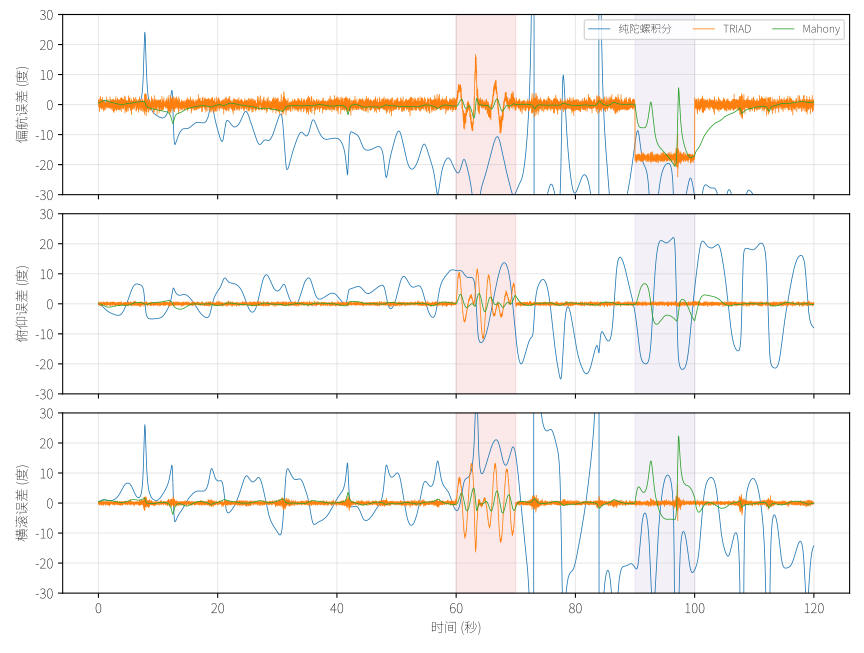
纯陀螺积分。 误差随时间单调变坏:10 秒时总误差 6.6 度,60 秒 23.6 度,120 秒 41.9 度,RMSE 25.979 度。零偏 rad/s 的量级,一阶估算 120 秒会积出 2.4 rad(约 137 度);实际只有 41.9 度,我猜是因为机体一直在转,零偏造成的误差在世界系里方向不断变化,一部分互相抵消了(这是推测,我没有单独验证)。图里偏航和横滚曲线上的尖峰是欧拉角折到 的缠绕,加上俯仰接近 80 度时的万向锁放大,不是旋转本身的突变。
TRIAD。 没有漂移,没有记忆,每个样本的噪声直接进来,所以横滚和俯仰的”毛刺”最大。线加速度扰动段 ,总误差 8.247 度,对比平静段 1.044 度:加速度计把线加速度当成了重力的偏转。磁干扰段,TRIAD 的偏航被拉偏,平均偏 。可以手算验证:磁场的水平分量从 变成 ,方向偏转 。
Mahony。 平静段 0.758 度,线加速度段 2.331 度(比 TRIAD 的 8.247 度好得多:陀螺在这十秒里主导,加速度计的坏数据只通过 慢慢渗进来)。但磁干扰段的总误差是 14.851 度,其中横滚和俯仰部分是 8.437 度。TRIAD 在这一段,横滚和俯仰不受磁力计影响;Mahony 却会:它把磁干扰当作一个”姿态失配”,用 去修正,而这个叉乘有一部分落在横滚和俯仰方向上。偏航被拉偏平均 ,比 TRIAD 的少,但没有消除。
整体 RMSE 4.881 度对比 TRIAD 的 5.702 度,好得有限,因为它们共同的最大误差来源是磁干扰那 10 秒。这件事需要的不是更好的增益,而是让滤波器理解”磁力计只能影响偏航”,并在传感器不可信的时候知道。这是第 5、6 篇的主题。
下一篇
Mahony 滤波器已经能用,但它的两个增益 和 是我选的,没有来由,也不会随工况变化。下一篇我们用第 1、2 篇的推导重新做一遍:状态是四元数加陀螺零偏共 7 维,过程模型是 ,测量是加速度计和磁力计的方向向量,非线性,所以要线性化,这就是扩展卡尔曼滤波。它能不能赢过 Mahony,以及为什么 的四元数协方差天生有一个方向的特征值是 0,是第 5 篇的内容。
支持与分享
如果这篇文章对你有帮助,欢迎分享给更多人或打赏支持!